


Paper of the Month
Bothy Bags
Posted by Mike Greene on Mar 29, 2026

How Effective is a Bothy Bag?
Troeger W, Winkler M, Isser M, Lederer W. Shelters in alpine rescue: can they create a comfortable zone at the deployment site? Wilderness & Environmental Medicine. 2025 Jun;36(2):159-65.
Available at: https://journals.sagepub.com/doi/pdf/10.1177/10806032241300132
Scenario
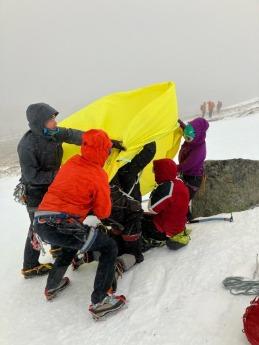
You are managing a mountain emergency in difficult Scottish conditions. As you struggle to deploy the bothy bag in the wind, you wonder just how effective it is and if this really matters.
Background
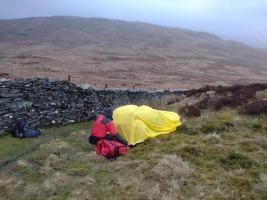
The bothy bag, bivvy bag or emergency shelter is a British invention. The original was the KISU (Karrimor Instructor Survival Unit), developed by Ken Ledward and Mike Parsons of Karrimor and first manufactured in the 1970s. It followed some high-profile accidents in which the lack of shelter was identified as a significant factor in deaths caused by hypothermia. Bothy bags have been used for almost 50 years and are carried by individuals, groups and rescue teams. So, you might be surprised that there is very little objective assessment of their efficiency. That is, until last year when this paper was published by the Austrian Rescue Association.
What did they do?
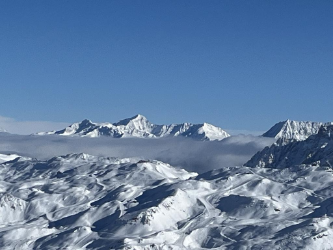
This was a prospective, observational study performed in the Austrian Alps by rescue team members. The scenario involved 48 rescuers performing 15 minutes of CPR on a manakin, inside a bothy bag. They measured outdoor air temperature and humidity and compared these with the conditions inside the shelter at the end of 15 minutes. The median temperature outside was -1.2°C (IQR -7.7 to - 0.8°C). The relative humidity outside was 66-70%. There was no precipitation and the wind was NE-E <20km/hr. Tests were performed at the altitudes of 1407m, 2165m and 1918m on snow-covered terrain.
After 15 minutes, the median temperature inside the bothy was 10.9 °C (IQR 9.3 to 14.1 °C). Overall, the median rise in temperature was >15 °C (IQR 14.3 °C - 16.5 °C).
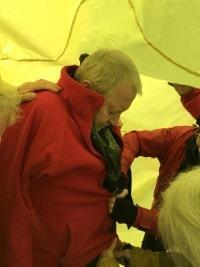
The paper gives details of other parameters, such as carbon dioxide and oxygen concentrations but these changes were not clinically significant. They also recorded the rescuer's subjective assessment of the functional suitability of the environment in the bothy bag using a 5-item Likert Scale, which showed satisfaction with the working environment inside the shelter. The authors remind us that an immobile patient also loses heat by conduction and they must be insulated from the ground.
Why is this paper useful?
This paper provides objective evidence to our subjective assessment that bothy bags "seem" to work. The provision of shelter is an essential part of managing any mountain emergency. Convection is a major component of heat loss, particularly in windy and wet conditions in the British mountains. Primary accidental hypothermia is a potentially life-threatening condition, but cooling to 36°C and below is also an independent risk factor for mortality and morbidity in patients with serious injury. Providing early shelter and minimising heat loss is therefore part of life-saving treatment. It is an important part of the management of "C" in the Primary Survey.
Next month we will be sticking our necks out when we look at one of the latest publications on the sometimes controversial topic of cervical spine injury.

Comments
Leave a comment.
Submit Comment
Leave a comment.

 )
) Bronze
 Silver
 Gold
Gold Platinum
 Palladium
 Internal