



Hemingway R, Stourton F, Leckie T, Fitzpatrick D, Jones G, Wood F, Boalch A, McNulty-Ackroyd J, Thurgood A, Boulter M, Hartle A. Faculty of Pre-Hospital Care: consensus statement on the prehospital management of exertional heat illness. Emergency Medicine Journal. 2025 Jun 1;42(6):390-5.
Access at:https://scholar.google.com/scholar?hl=en&as_sdt=0%2C5&q=Faculty+of+Pre-Hospital+Care%3A+consensus+statement+on+the+prehospital+management+of+exertional+heat+illness&btnG=
Case Example
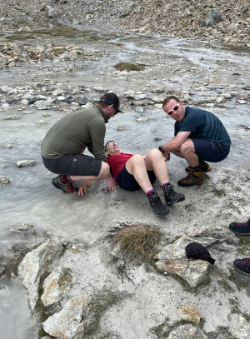
A male security officer in his twenties became confused while walking up Scafell in the English Lake District on a warm day in June. He thought he saw fighter jets attacking him. These were hallucinations. He became confused and agitated. His friend coaxed him to a small lake and laid him in the water. When the rescue team arrived, his central nervous system symptoms were resolving. In hospital, he was treated on the ITU and had a short period of renal support, but made a complete recovery.
Consider the following questions before reading this month's paper.
- What were the possible diagnoses?
- What was your working diagnosis and why?
- What was important about his treatment?
Introduction
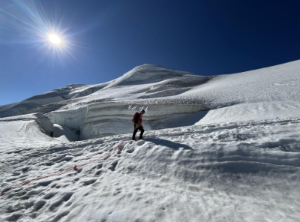
This month we look at an important paper on heat illness. I have just returned from the European Alps, where it has been very warm and in the UK there have been record-breaking hot days. As climate change alters our weather, we are likely to see more heat illness in the UK mountains. This is a good time to remind ourselves how to recognise and treat severe heat illness.
What did the authors do?
They conducted a literature search and asked experts in the pre-hospital care of patients with exertional heat illness (EHI) to evaluate the evidence. The results were written as consensus statements, each of which was graded (for the level of evidence) and referenced. The focus was on the pre-hospital recognition and treatment of EHI. The advice is suitable for a range of providers.
What are some of the important messages?
- Heat illness is likely to become more common.
- Exertional heat illness (EHI) is a spectrum of conditions, the most severe of which is "heat stroke" (severe exertional heat illness).
- Severe exertional heat illness (SEHI) is a time-critical condition.
- The key diagnostic feature of SEHI is a change in central nervous system (CNS) function. However, this is not like a "stroke" with a focal sign that a FAST test can recognise, but an encephalopathic pattern with features of general confusion and subtle changes in behaviour.
- SEHI affects multiple body systems and can lead to multiorgan failure and death (shock, cardiac arrhythmias, seizures, coma and cardiac arrest).
- Core body temperature measurement (Tc) may not be available in the field and the thermometers commonly available are inaccurate at these temperatures.
- "Think" SEHI for any patient with exercise + hot environment + CNS features.
- Cold water immersion is the treatment of choice. It should be started immediately and must not be delayed for patient transfer.
- Shade, strip, spray and fan (S3F) is an alternative strategy for cooling patients when CWI is not possible.
- Transfer all patients with an episode of SEHI to hospital after initial treatment.
Background information
What to do if Tc is available
When an accurate temperature measurement is available, it can help make a diagnosis: mild heat illness usually occurs between 38.5 °C and 40 °C, and SEHI usually occurs at temperatures > 40 °C. However, not all individuals have the same physiology and anyone with CNS dysfunction must be considered to have SEHI in suitable environmental conditions. If temperature measurement is available, then we can stop cooling between 38.5 °C and 39.0 °C. But if it is not, cool until symptoms resolve.
Time-critical cooling
SEHI is a multisystem disease with a significant mortality. If patients are cooled to below 39.0 °C within 20 minutes of symptom onset, they will survive with minimal or no morbidity. CWI has been shown to have a cooling rate of 0.2 °C/min and S3F of 0.1 °C/min. This has been reported when using water at temperatures between 2 °C and 20 °C. Using these figures, if a patient with SEHI has a temperature of 41 °C, CWI could cool them in approximately 10 minutes and S3F in 20 minutes.
Does this paper change your practice? Place a comment in the space below to engage with other members of the BMMS community.

Comments
Leave a comment.
Leave a comment.

 )
) Bronze
 Silver
 Gold
Gold Platinum
 Palladium
 Internal